ERP vs. WMS: What’s the Difference and Which Do You Need?
Compare ERP and WMS, see how standalone and integrated systems differ, and learn when an ERP WMS may be the better fit for your warehouse.
6 min read
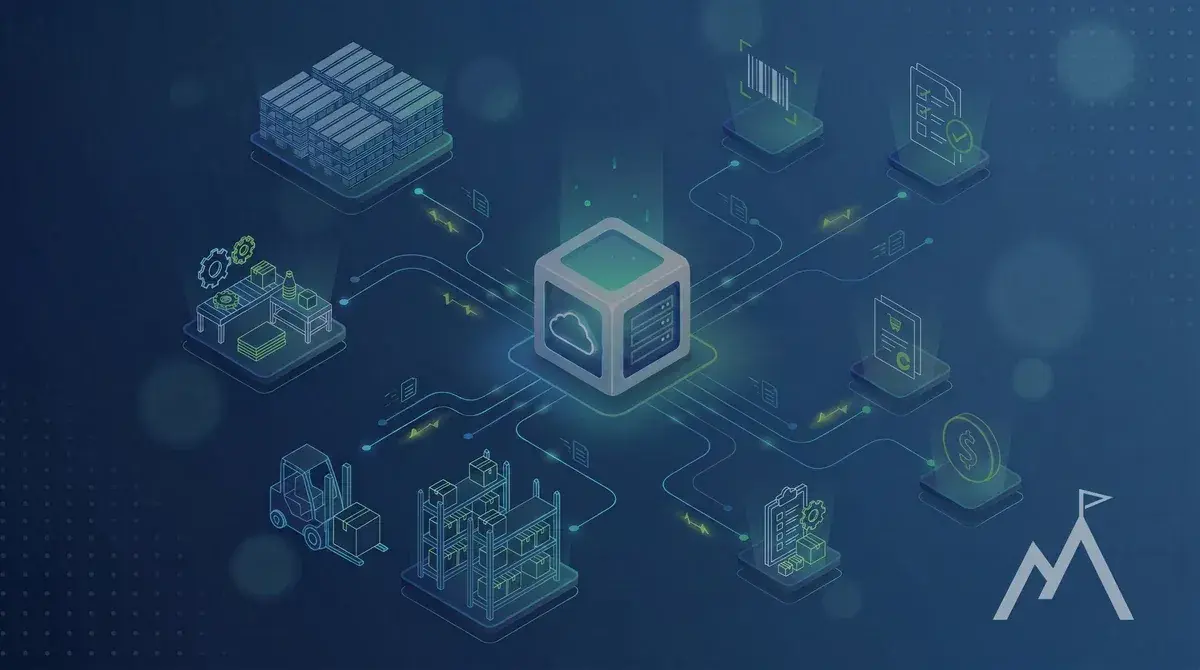
Most manufacturers don't struggle with inventory because they're doing something wrong. They struggle because the business grew past what the current system was built to handle.
Raw materials sit in one place. WIP lives in a spreadsheet. Finished goods carry costs nobody fully trusts. And by the time finance pulls everything together at month-end, the picture is already out of date.
At some point that stops being a process problem and starts being a system problem.
Most businesses in that situation started on something like QuickBooks, added a tool like Fishbowl when inventory got complicated, and ended up with production tracking in spreadsheets because neither system handled WIP and job costing the way a manufacturer needs. If that path sounds familiar, we covered the signs businesses outgrow QuickBooks in more detail here.
This guide is for manufacturers who are starting to evaluate options and want a practical look at what matters.
Most manufacturers don't start with a full manufacturing inventory platform. They grow into the need over time.
The QuickBooks and Fishbowl combination works better than QuickBooks alone, but the two systems were never designed as one. The integration can becomes harder to maintain. Finance is working from QuickBooks while operations is working from Fishbowl and the two aren't always in sync. WIP and job costing still end up in spreadsheets because neither system handles them the way a manufacturer needs. If you're weighing whether to stay or move, it may also be helpful to compare how QuickBooks and Acumatica handle growing complexity before making any decisions.
Legacy systems have a different problem. They technically have manufacturing modules, but the systems are decades old, running on outdated infrastructure, patched together and customized so many times that only a couple of people in the company still understand how it works. Finance has learned to work around them and production has its own tracking, which can create a scramble to reconcile at month-end.
What was built for the business decades ago made sense at the time. The problem is the business kept growing and the system stayed the same.
In our experience working with manufacturers evaluating ERP, these issues tend to show up long before leadership formally decides it's time for a new system.
There's rarely one single moment when it becomes obvious you need new software. It's usually a pattern of problems that keep repeating.
If planners and production managers are tracking work in progress in spreadsheets because the system has no real concept of WIP by job or work center, that's a problem. Production has its own view of reality, finance has another, and leadership is usually stuck somewhere in the middle trying to figure out which number to trust.
Planning is reactive instead of proactive. The team spends too much time expediting and paying rush freight fees because there's no reliable view of what's on hand, on order, and allocated. The frustrating part is you often have too much inventory overall, just not the inventory you actually need.
Different reports show different numbers. Finance isn't confident in job costing and product profitability is hard to see clearly until after the fact. By the time the problem shows up clearly, the job is already complete and there isn't much left to fix.
Closing the books means reconciling physical counts, spreadsheets, and the general ledger before anyone can produce a reliable report. It takes too long and depends on too few people.
Sales, production, and finance all have their own version of the truth. Each group feels like the other is working from wrong information, because they usually are.
If two or three of these sound familiar, you're probably past the point where workarounds are a viable long-term answer.
Before you start looking at vendor names, it helps to define what good actually looks like.
Manufacturing inventory management software should do more than track quantities in and out. At a minimum it should give you a single trusted view of inventory across raw materials, WIP, and finished goods, tie inventory tightly to production, purchasing, and sales orders, handle your costing method correctly and consistently, and give finance and operations real-time visibility instead of after-the-fact reports.
In other words, you want a system that understands how your plant actually runs today and how you expect it to run in a few years.
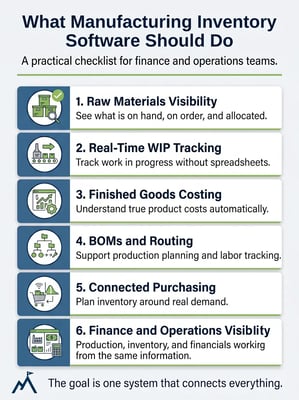
From a finance and operations perspective, good inventory software has to respect the differences between each stage of inventory.
Raw materials. Your system should show what's on hand, what's on order, and what's already allocated to existing production orders. Planners need clear visibility into shortages and suggested purchases so production doesn't stall waiting on components.
Work in progress. WIP should not live in a spreadsheet. When it does, finance struggles to trust inventory valuation, production leaders lack visibility into bottlenecks, and leadership loses confidence in margin reporting. Manufacturing inventory software should track material issues, labor, and overhead as work moves through the routing so you can see WIP by job, order, and work center in real time. For most manufacturers this is the hardest part to get right and the most important.
Finished goods. By the time a product hits finished goods, the system should already know its true cost. That means rolled-up material, labor, and overhead, not a rough standard or a manual journal entry. If finished goods costs are right, margin reporting and pricing decisions improve significantly.
When a system can see and connect all three stages cleanly, planners stop guessing, finance trusts the numbers, production can schedule with confidence, and leadership gets real visibility into margin and cash flow. Inventory stops being a black box and starts being a lever for the business.
For manufacturers, inventory control and production control are inseparable. That's why bills of material, routing, and costing are non-negotiable.
Bills of material. You should be able to maintain single-level and multi-level BOMs inside the system, including alternates and revisions. Engineering changes should flow through to planning and costing without hand-editing spreadsheets.
Routing. Routings define how work actually flows on the floor. Your software should let you define work centers, operation steps, and standard times so you can schedule realistically and calculate labor and overhead accurately.
Costing. Whether you use standard, actual, or another method, costs should roll automatically from raw materials to WIP to finished goods. You shouldn't have to do heavy lifting at month-end just to get a true picture of product and job profitability.
When BOMs, routing, and costing all live in one platform, you stop fighting your tools and start improving your process.
Once it's clear the current system is limiting the business, a few questions usually follow.
Do we add another bolt-on to what we have, or is it time for a new platform? If we move, do we pick a manufacturing-only tool and keep separate financials, or do we move to a full ERP? And can we realistically implement this without disrupting the plant during a busy stretch?
Many manufacturers initially look at point solutions that sit on top of QuickBooks or an older ERP. These can help for a while, but you still end up with fractured data and more moving parts to maintain. The other path is a true manufacturing-capable ERP that covers inventory, production, purchasing, and financials in one connected system. That's where Acumatica's manufacturing platform enters the conversation for a lot of the manufacturers.
Most of the manufacturers we talk to aren't looking for more software. They're trying to get finance, production, inventory, and costing working from the same information. That's usually the starting point for a useful conversation.
If two or three of the signs in this guide sound familiar, the next step probably isn't a software demo. It's getting clear on where the current system is actually breaking down and what a better process would need to look like.
That's the conversation we usually have with manufacturers first. No pitch, no pressure, just a practical conversation about where things stand today, what's creating friction, and whether a more connected manufacturing platform makes sense for where the business is headed.
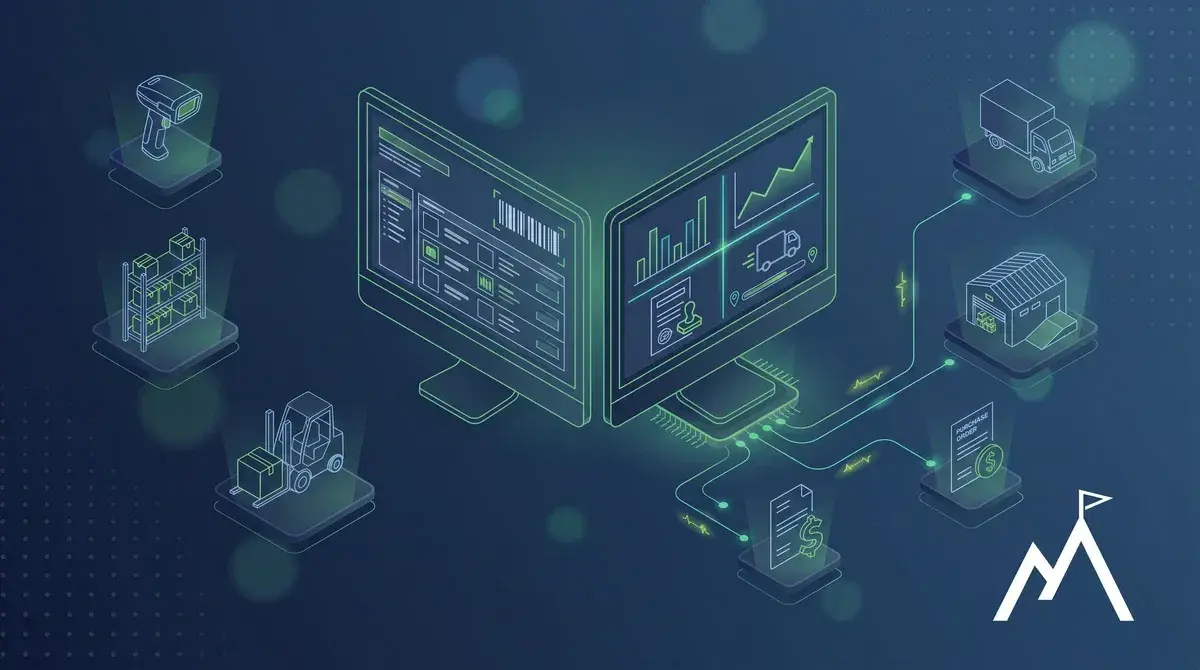
Compare ERP and WMS, see how standalone and integrated systems differ, and learn when an ERP WMS may be the better fit for your warehouse.
Acumatica WMS connects picking, packing, and shipping in one platform. Learn how barcode-driven workflows reduce errors and improve fulfillment...
See how construction inventory management software helps contractors track materials, improve job costing, and give finance numbers they can trust.