What Is Multi-Entity Accounting? How It Works and When You Need It
Learn what multi-entity accounting is, how intercompany transactions and consolidation work, and when separate company files stop being enough.
5 min read
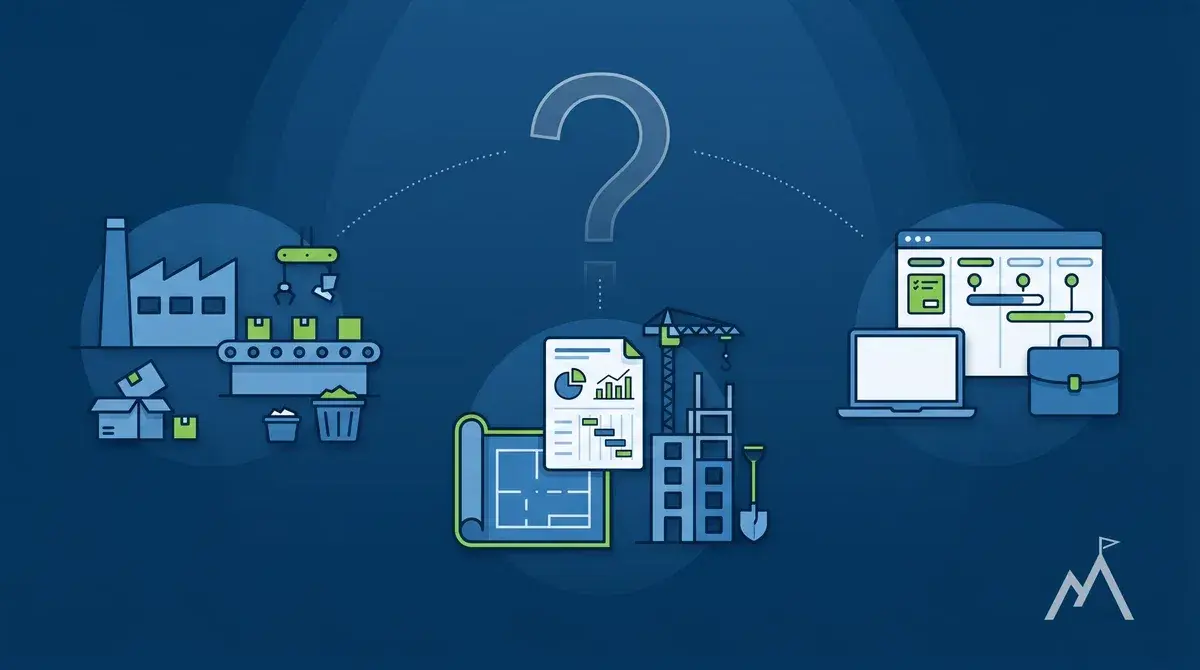
Most people assume WIP means the same thing everywhere, but it doesn't. In construction, WIP usually means work in progress and has everything to do with job financials, billings, and how far along a project is. In manufacturing, it often means work in process and refers to inventory somewhere between raw materials and a finished product. In professional services, it may refer to time and costs that have been incurred but not yet billed. Same acronym, completely different conversation.
That confusion comes up more often than you might think, especially during ERP evaluations, accounting discussions, or when teams from different industries are trying to compare how they report on things. Here is the simple difference and when each term actually applies.
Work in process usually refers to partially completed goods in manufacturing. Work in progress usually refers to longer-term projects or work that has started but is not finished yet.
Both describe work that is underway. Both have financial value attached to them. The difference is that work in process is tied to production and inventory, while work in progress is more often tied to projects, contracts, and ongoing client work.
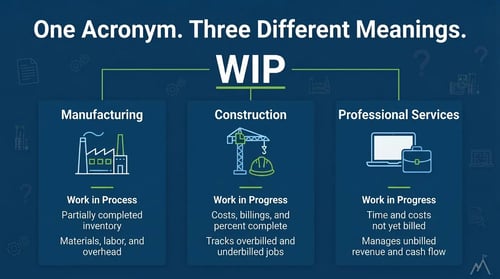
The confusion comes from the fact that both terms use the acronym WIP. A manufacturer talking about inventory and a contractor talking about job performance might both say "WIP" while describing completely different things. Add software systems that use the terminology differently, and it is easy to see why the terms get mixed up.
Work in process is a manufacturing term. Think about a product that is halfway through assembly. Materials have been consumed, labor has been applied, but the product is not ready to ship yet. That is work in process. Those partially finished goods usually sit in a work-in-process account until production wraps up and they move into finished goods.
This is the right term for businesses that make products, run repeatable production processes, and need to know what value is tied up at each stage of the line.
If you are running a manufacturing operation, work in process is the more accurate term.
Work in progress shows up across a lot of industries. In construction it means active jobs that are underway but not complete, and WIP reporting tracks job costs, how far along the work is, what has been billed, what has been earned, and whether a job is overbilled or underbilled.
In professional services like consulting, legal, architecture, and engineering, work in progress usually refers to time and costs that have been put into a client engagement but have not been billed or recognized as revenue yet. It also shows up in accounting for long-term capital projects or assets that are being built out over time.
What all of these have in common is that work happens before revenue is fully recognized, and someone needs a way to track what has been spent, what has been billed, and what is still outstanding.
In construction, WIP is not just a label. It is one of the most important financial reports a contractor can run. Most contractors are not looking at a WIP report because they enjoy spreadsheets. They are looking at it because they want to know if a job is heading in the wrong direction before it turns into a margin problem.
WIP reports show where a job stands based on costs so far, how complete the work is, what has been earned, what has been billed, and where the job is headed. Finance teams are usually trying to answer a few simple questions. Is the job overbilled or underbilled? Are margins holding up? Are we catching problems early enough to do something about them?
Good WIP reporting helps contractors spot trouble on a job before it gets expensive. We cover this in more detail in our construction WIP reports guide.
Work in progress fits here because the work is tied to contracts, budgets, and billing schedules, not to products sitting on a production floor.
For professional services firms, WIP usually comes down to billing and when revenue gets recognized.
A consulting firm wants to know how much unbilled time and expense is sitting on active work. A law firm needs to track hours that have been worked but not yet invoiced. An architecture or engineering firm on a long project may be watching costs pile up against what has actually been billed.
In all of these cases, work in progress is value the business has already created but has not collected yet. When that goes unmanaged, it leads to billing delays, cash flow problems, and financial reports that do not tell the full story.
As a general rule, work in progress makes sense for construction, professional services, and any business that ties revenue to projects or ongoing client work. Work in process makes sense for manufacturing and production environments.
If you are setting up reports, configuring a system, or training your team, consistency matters more than debating which phrase is technically correct. Pick the one that fits how your business actually works and use it the same way across finance, operations, and leadership.
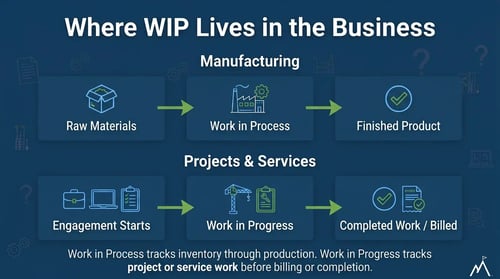
The important thing is understanding how your industry uses the term. In manufacturing, WIP typically refers to inventory moving through production. In construction and professional services, it usually refers to work that has been completed but not yet billed or fully recognized as revenue.
While the terms are sometimes used interchangeably, the underlying meaning is very different. Understanding that distinction helps when reviewing financial reports, discussing accounting processes, or making sure your ERP is configured to match how your business actually tracks work.
Whether you call it work in progress or work in process, the goal is the same. You need visibility into work that has started but is not finished, and you need it before surprises show up at month-end. The terminology matters less than having accurate information. If you want to talk through what that could look like for your business, we are happy to help.

Learn what multi-entity accounting is, how intercompany transactions and consolidation work, and when separate company files stop being enough.
Outgrowing QuickBooks? Learn the signs that reporting, access, add-ons, multiple entities, and manual work may mean it is time to evaluate ERP.

Master project management in the construction with Acumatica ERP, integrating budgeting, reporting, and collaboration to ensure project success.