Accounting Software for Multiple Businesses
Learn how accounting software for multiple businesses helps finance teams manage intercompany transactions, reporting, and financial visibility.
6 min read

When an organization operates multiple companies, accounting becomes more complex.
Each company may need its own books, financial statements, bank accounts, and tax reporting. At the same time, ownership and leadership still need to understand how the overall organization is performing.
That is where multi-entity accounting comes in.
Multi-entity accounting is the process of maintaining separate financial records for two or more related companies while also managing transactions, reporting, and financial consolidation across the organization.
It is commonly used by businesses with subsidiaries, holding companies, acquisitions, separate LLCs, or other related companies under common ownership.
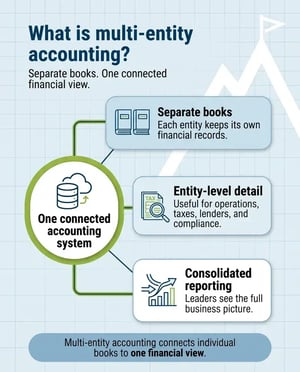
The goal of multi-entity accounting is to keep the financial records of each company separate while still giving finance and leadership visibility across the organization.
A multi-entity structure usually involves five main areas.
Each legal entity still needs its own financial records.
The companies may be related, but finance still needs to know exactly which entity each transaction belongs to.
Related companies do not always need to use the exact same chart of accounts.
But keeping the accounting structure consistent, or mapping accounts to a common reporting structure, makes consolidated reporting much easier.
Companies may also align financial calendars and reporting structures where it makes sense.
Without that consistency, finance teams often spend more time manually adjusting or mapping financial information before they can produce accurate consolidated reports.
Related companies frequently transact with each other.
One company may pay an expense for another. Inventory may move between companies. One entity may loan money to another, provide services, or allocate shared costs.
These are called intercompany transactions.
Accounting teams need to record both sides of those transactions correctly so the books for each entity remain accurate and balanced.
Leadership may also need consolidated reporting that shows how the companies included in the reporting group are performing together.
For example, an organization with three subsidiaries may need to see:
This is known as multi-entity consolidation.
Simply adding the financial statements together is not enough.
Transactions between related companies included in the consolidation generally need to be removed from the group-level financial statements so revenue, expenses, assets, and liabilities are not counted twice.
For example, if Company A sells $50,000 of inventory to Company B, that transaction belongs on the individual books of both companies.
But in the consolidated financial statements, the intercompany sale and related balances need to be eliminated so the organization does not appear to generate revenue by selling to itself.
Consider a business owner with three related companies.
Holding Company
Owns the other businesses and handles certain shared expenses.
Distribution Company
Purchases inventory and sells products to customers.
Service Company
Provides installation and field services.
Each company needs its own books.
But the companies also interact.
The holding company may pay insurance that needs to be allocated between the businesses. The distribution company may provide products to the service company. Cash may occasionally move between entities.
Finance has to account for each transaction at the individual company level while still being able to produce financial statements for the organization as a whole.
That is multi-entity accounting.
Multi-entity accounting and multi-company accounting are often used interchangeably.
Both generally describe an organization managing the financial records of multiple related companies while keeping separate books for each one.
This article focuses on separate legal companies rather than divisions or departments within one company.
The important question is whether finance can maintain accurate records for each company while also managing intercompany activity and consolidated reporting across the organization.
Adding another company does not simply mean adding another set of books.
Finance teams also have to manage the relationships between those books.
Some of the most common challenges include:
Companies using separate accounting files often export financial statements into Excel and combine them manually.
That may be manageable with two small companies, but the process gets harder as more entities and transactions are added.
Every intercompany transaction has two sides.
If one side is recorded incorrectly or in a different accounting period, finance has to find and reconcile the difference before closing the books.
One company may record an expense differently than another.
Those differences can make consolidated reporting harder and may force finance teams to maintain spreadsheets just to map accounts between companies.
Insurance, software, payroll, professional services, rent, and other expenses may need to be divided between multiple entities.
Finance needs a consistent way to allocate those costs and record the appropriate intercompany entries.
Consolidated reporting depends on each company having accurate financial information.
If one entity has not completed its close, the organization-wide reporting may also be delayed.
Separate company files can make it difficult for leadership to answer basic questions about the organization as a whole.
How much cash do we have across the companies? Which entity is most profitable? What does total accounts receivable look like?
When those answers depend on someone manually combining reports, financial visibility becomes slower.
Simply owning two companies does not automatically mean you need a new accounting system.
A small organization with two simple entities and very little activity between them may be able to manage separate company files without much difficulty.
The need usually becomes clearer as more moving parts are added.
Common signs include:
The real question is not how many entities you have.
It is how much work is required to keep them separate, connected, and accurately reported.
Multi-entity reporting gives finance teams the ability to view financial information at different levels of the organization.
A controller may need an income statement for one company while the CFO needs consolidated financials covering the reporting group.
Good multi-entity reporting should make both possible.
Finance should be able to look at individual companies, compare entities, and view consolidated results without rebuilding the financial statements in spreadsheets every month.
Multi-entity consolidation combines the financial results of related companies into one set of group-level financial statements.
The process can include:
For companies managing several entities, automating more of this process can reduce the amount of spreadsheet work required during month-end.
Separate accounting files can work well for a while.
Problems usually start when finance has to build more processes outside the accounting system to keep everything connected.
One spreadsheet consolidates the financials. Another tracks intercompany balances. Another handles shared expenses. Someone maintains a separate report for leadership.
At that point, the accounting system may still technically handle each individual company, but the finance team is doing more and more work outside the system to manage the organization.
That is usually when businesses begin evaluating whether they need a system designed to manage multiple companies together.
Understanding multi-entity accounting is the first step.
The next question is whether your current accounting system can manage it efficiently.
That includes looking at how the system handles intercompany transactions, consolidated reporting, entity-level financials, shared information, user access, and reporting across the organization.
If you are at that stage, our guide to accounting software for multiple businesses covers the software side in more detail, including the capabilities to look for when evaluating a multi-company accounting system.
For businesses that need broader financial and operational management, you can also learn more about Acumatica financial management.
An ERP consultant can also help determine whether the issue is the accounting system itself or the processes around it.
Learn how accounting software for multiple businesses helps finance teams manage intercompany transactions, reporting, and financial visibility.

What construction finance leaders ask before choosing an ERP. Milestone IS covers the seven questions — job costing, implementation, and ROI.

Compare QuickBooks and Acumatica to see when it's time to move from accounting software to a cloud ERP built for reporting, controls, and operations.