What Is Multi-Entity Accounting? How It Works and When You Need It
Learn what multi-entity accounting is, how intercompany transactions and consolidation work, and when separate company files stop being enough.
4 min read
Accounting software for multiple businesses lets an organization manage the finances of more than one company in a single system. Each business can maintain its own books while finance teams report by individual company or view consolidated results across the organization without relying on separate systems and spreadsheets.
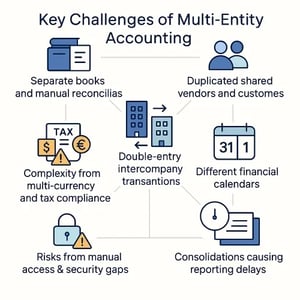
As a company adds businesses, the accounting workload grows with it. Separate systems, manual reconciliations, and limited visibility can make it harder to keep financial information aligned and reporting on time. What began as routine accounting can turn into managing intercompany activity, shared vendors, consolidated reporting, different currencies, and separate financial requirements across multiple businesses.
For companies managing multiple entities, the challenges often look similar:
These challenges create more work for finance teams and make it harder to get timely, accurate financial information. As the number of entities grows, reporting, visibility, and control often become more difficult to maintain.
When comparing accounting software for multiple businesses, the most important question is whether the system can keep each company financially separate while still giving finance visibility across the entire organization.
Finance should be able to view results for one business, a group of businesses, or the entire organization without rebuilding reports in spreadsheets.
Transactions between related companies should be easier to manage, reconcile, and report without relying on separate spreadsheets or duplicate entry.
Each company should maintain its own general ledger and financial records while operating within one connected platform and using shared structures where appropriate.
Permissions should be controlled by company, role, or responsibility so users have access to the financial information they need without seeing information they should not.
Organizations operating across currencies need a system that can support financial activity and reporting across different entities and locations.
As the organization adds companies, locations, or business units, the accounting system should support that expansion without requiring finance to start over with another separate system.
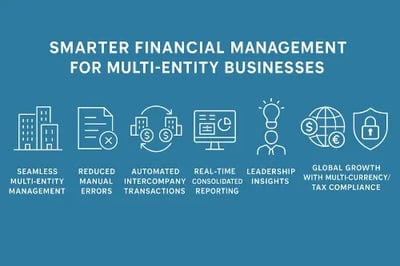
A system built for multiple businesses can reduce manual work, make consolidated reporting easier, and give finance better visibility across the organization.
Many organizations begin by running each business in its own accounting file or separate accounting system. That can work well when there are only one or two companies and relatively little activity between them.
As more businesses are added, finance teams often find themselves logging in and out of separate systems, exporting financial information into spreadsheets, rebuilding consolidated reports, and manually reconciling transactions between companies.
Accounting software designed for multiple businesses brings that work into one connected platform. Each company can maintain its own financial records while finance manages reporting, intercompany activity, and financial visibility across the organization from one system.
For many finance teams, that becomes the natural next step once managing separate accounting systems starts taking more time than managing the accounting itself.
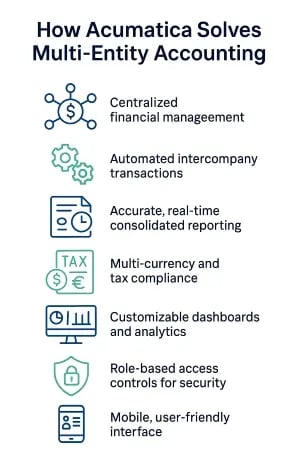
As the number of entities grows, managing the financial side of the organization becomes more involved. Acumatica helps bring financial management, reporting, and intercompany activity into a single ERP platform.
Acumatica allows finance teams to manage multiple entities within a single platform. General ledger, accounts payable, accounts receivable, purchasing, and cash management can be managed across entities while maintaining separate financial records where needed.
Transactions between entities can be managed within the same system, helping reduce duplicate data entry and making reconciliation easier as transaction volume increases.
Financial results can be consolidated across entities without relying on spreadsheets or separate reporting tools. Leadership can review consolidated financials, then drill into individual entities when additional detail is needed.
Organizations operating across multiple currencies can manage financial activity and reporting within the same system. Acumatica supports currency conversion and financial reporting across entities operating in different currencies.
User permissions can be configured by role, entity, department, or responsibility. Finance teams can move between entities while maintaining appropriate controls over who can view, enter, approve, and report on financial information.
As organizations add entities, locations, business units, or international operations, finance has more information, reporting, and controls to manage. Acumatica helps keep financial data, reporting, and controls connected as the organization changes.
Intercompany accounting becomes harder as transactions increase between subsidiaries, divisions, or related companies. Finance has to keep both sides of the transaction aligned while maintaining accurate balances and financial records for each business.
Multi-entity accounting software helps keep that activity within the same financial system, making it easier to manage due-to and due-from balances, reconcile activity between companies, and prepare consolidated financial reporting without rebuilding the information in spreadsheets.
For finance teams managing several related businesses, having intercompany activity connected to the same accounting platform can reduce the amount of manual reconciliation required at month-end.
When each business operates in a separate accounting system, finance often has to move information between systems before it can see the organization as a whole.
| Separate Accounting Systems | Multi-Entity ERP |
|---|---|
| Separate logins and company files | Multiple entities managed in one platform |
| Consolidation built in spreadsheets | Consolidated financial reporting |
| Intercompany activity reconciled manually | Intercompany activity managed within the same system |
| Information spread across systems | Financial visibility across the organization |
| More work during month-end | Fewer separate systems to reconcile |
The advantage is not simply having multiple companies in one system. It is giving finance a clearer way to manage separate entities without operating separate financial environments.
Learn more about multi-entity accounting: Explore financial management in Acumatica, or see what multi-entity accounting is and when your business needs it.

Learn what multi-entity accounting is, how intercompany transactions and consolidation work, and when separate company files stop being enough.

What construction finance leaders ask before choosing an ERP. Milestone IS covers the seven questions — job costing, implementation, and ROI.

See how Acumatica inventory management connects stock, purchasing, warehouses, costing, and financials in one cloud ERP for better visibility and...