Acumatica Inventory Management: How It Works and Who It Is For
See how Acumatica inventory management connects stock, purchasing, warehouses, costing, and financials in one cloud ERP for better visibility and...
6 min read
Inventory problems rarely start in the warehouse.
That's just where they become impossible to ignore.
By the time your team is dealing with stockouts, excess inventory, rushed freight charges, or someone walking the aisles to double-check what the system says, the real problem has usually been building for a while.
Maybe purchasing is running on gut feel instead of actual demand. Maybe inventory lives across spreadsheets, disconnected systems, and reports nobody fully trusts. Or maybe the business has simply grown past what the current system was built to handle.
Whatever is causing it, the result usually feels familiar. Frustrated customers. Cash tied up in the wrong inventory. Purchasing reacting instead of planning. Accounting trying to sort everything out at month-end. And leadership struggling to get a clear picture of what inventory is actually costing the business.
In our work with distributors evaluating whether they've outgrown their current systems, we see the same challenges come up again and again. Here are seven of the biggest ones, what causes them, and what actually helps.
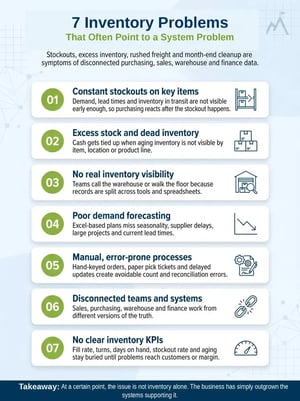
One warehouse runs out of a high-velocity item while another location has inventory sitting on the shelf that nobody knew was available. Purchasing rushes a replacement order, sales has to explain the delay, and margin takes a hit because of rush freight that probably could have been avoided in the first place.
This usually comes down to forecasting that relies on rough guesses, static reorder points that were set years ago and never revisited, and limited visibility to what's actually on hand and in transit across locations.
Better inventory systems help by pulling real demand history, lead times, and seasonality into the replenishment process so purchasing isn't working from instinct. When inventory falls below a dynamic reorder point, the system flags it before the stockout happens rather than after.
On the other side of the same problem, you may be sitting on product that isn't moving.
Excess inventory quietly becomes a finance problem. Cash gets tied up in product that has no near-term demand. Six months later, finance is asking why cash feels tight while shelves are full of inventory nobody has touched. Carrying costs increase, and eventually accounting has to deal with write-offs or margin pressure that could have been avoided with better purchasing decisions upstream.
Most of the time this happens because there's no clear view of how inventory is aging by item, location, or product line. By the time it shows up as a problem, it's already been a problem for months.
Inventory aging reports and replenishment rules by item class help purchasing treat high runners and slow movers differently instead of applying the same logic across the board.
If a customer asks whether something is in stock and your team has to call the warehouse or walk the floor to find out, that's a visibility problem.
When inventory data lives across multiple systems and spreadsheets, you end up with mismatched records, partial shipments, and time wasted chasing down information that should be available in seconds. Sales overpromises. Warehouse scrambles. Finance cleans up the difference at month-end.
The fix is one inventory ledger across all locations, updated in real time as orders, receipts, transfers, and picks happen. What's on the screen matches what's actually in the building, and every team is working from the same numbers.
Most distributors are still forecasting in Excel. Someone pulls a download from the accounting system, builds a plan manually, and hopes it's close enough.
Seasonality, large projects, and promotions don't always make it into the plan. Lead times don't get updated when suppliers slip. One large customer order, a supplier delay, or a seasonal spike and suddenly purchasing is scrambling to adjust after the fact. The result is that you end up short on some items and long on others almost every cycle, and the root cause is hard to address because the forecasting process lives outside the system.
When forecasting is built into the inventory platform, it draws on actual sales history, seasonality, and current lead times to generate suggested demand. Purchasing connects directly to the forecast so you can see the impact of changes before you commit to them.
If your team is still keying orders by hand, printing pick tickets, and updating inventory counts after the fact, mistakes become a lot more likely.
Incorrect counts, wrong ship dates, and reconciliation work at month-end are almost always symptoms of the same thing: accounting software that wasn't built for real inventory control getting stretched past what it can do.
Barcoding and mobile scanning for receiving, picking, packing, and counting removes most of the manual keying. Cycle counts replace the annual physical inventory so accuracy stays consistent without shutting down operations.
Sales, purchasing, warehouse, and finance all care about inventory. But they're usually working from different tools and different versions of the truth.
What usually happens is pretty predictable. Miscommunication, double ordering, missed replenishment, and a lot of finger pointing when a customer is let down. Each team isn't wrong exactly, they're just working from incomplete information.
When inventory, orders, purchasing, and financials run on one connected platform, every team sees the same data. Approvals and exceptions route to the right people automatically instead of getting lost in email threads.
You can't manage what you can't see.
If leadership doesn't have a clear view of fill rate, inventory turns, days on hand, stockout rate, and aging by SKU or product line, inventory becomes a black box instead of a lever for margin and cash flow improvement. Most distributors in this situation aren't missing the data. It's scattered across systems and takes too long to pull together to be useful in real time.
When KPIs like fill rate, turns, days on hand, and aging are built into dashboards that update automatically, leadership can see problems developing before they show up as customer complaints or margin misses.
Not every inventory challenge requires a full ERP replacement. But when inventory, purchasing, warehouse activity, and financial reporting are all disconnected, it becomes difficult to scale without adding more manual work.
This is usually the point where companies start realizing the issue isn't inventory alone. It's the systems underneath it.
That's where connected platforms like Acumatica start making more sense. Instead of separate systems and spreadsheets, inventory, purchasing, sales, and finance work from one connected platform with real-time visibility across locations.
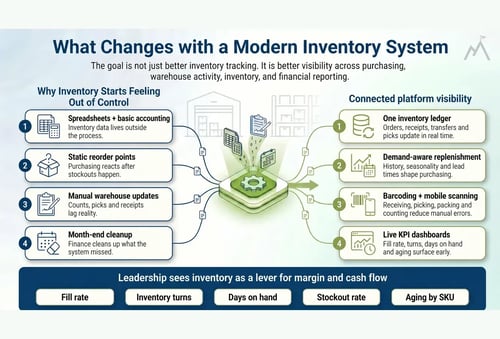
The goal isn't just better inventory tracking. It's better business visibility. If you want to see how Acumatica handles distribution specifically, that's covered in more detail on our Acumatica Distribution page.
Every distributor has inventory challenges from time to time. The real question is whether the problems are occasional or constant.
If you're seeing recurring stockouts, excess stock, frustrated customers, and month-end cleanup work almost every period, it's usually a sign the current system is stretched past what it was built to handle. Not because the team isn't capable, but because the business has grown more complex than the tools supporting it.
We see this most often in companies running multiple warehouses or locations on spreadsheets and basic accounting software, dealing with project-driven work or complex customer commitments the system can't reflect, or growing through new product lines, channels, or acquisitions without a common platform underneath.
At that point you don't just have inventory problems. You have a system problem.
If several of these problems sound familiar, it may not be an inventory issue alone. It may be a sign the business has outgrown the systems supporting it.
That doesn't automatically mean you need ERP tomorrow. But it usually means it's worth stepping back and understanding what's causing the bottlenecks and what better visibility could actually look like.
If it would be helpful to talk through where things stand today, we're always happy to talk about what's driving the bottlenecks and whether a more connected inventory platform makes sense for where the business is headed.

See how Acumatica inventory management connects stock, purchasing, warehouses, costing, and financials in one cloud ERP for better visibility and...
Compare ERP and WMS, see how standalone and integrated systems differ, and learn when an ERP WMS may be the better fit for your warehouse.
Acumatica WMS connects picking, packing, and shipping in one platform. Learn how barcode-driven workflows reduce errors and improve fulfillment...