1 min read
Streamlining Production Processes with Acumatica Production Management
Your production floor is the backbone of your manufacturing business. The accounting or sales department can be a well-oiled machine on its own, but...
3 min read

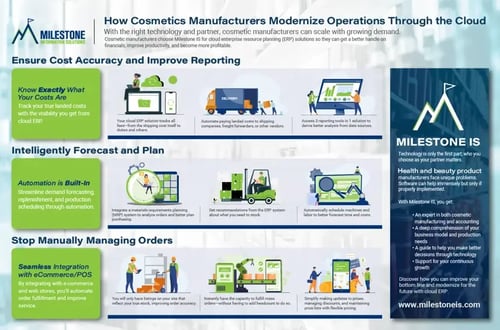
Cosmetics manufacturers have a lot more to manage than basic inventory and accounting. Products can involve ingredients, formulas, packaging, lots, expiration dates, landed costs, production steps, eCommerce orders, wholesale pricing, and customer-specific requirements.
Over time, those details get harder to keep connected. Inventory, production, purchasing, orders, and reporting may start in different places, but the information still has to line up.
When that gets harder to manage, many companies start looking for a better way to keep operations, inventory, and financial data connected in one system. That is where Acumatica comes in.
Cosmetics and beauty manufacturing depends on more than tracking sales and expenses. Inventory, costing, production, purchasing, fulfillment, and reporting all need to stay connected. A formula change, stock issue, lot concern, landed cost adjustment, or eCommerce order problem usually affects more than one area of the business.
Common challenges include:
The goal is not just another system. It is to keep finance, operations, purchasing, production, warehouse, and sales teams working from the same information.
Cosmetics and beauty companies often need more detail than a simple stock count can provide. Teams need to know what is available, where it is located, what needs to be replenished, and how inventory is moving through purchasing, production, warehouse activity, and fulfillment.
That gets harder when raw materials, packaging, finished goods, bins, warehouses, and customer orders all depend on accurate inventory. Acumatica helps bring those details into one system so teams can reduce manual updates, spreadsheet checks, and after-the-fact cleanup.
For growing manufacturers, stronger inventory visibility also supports replenishment planning, safety stock, min/max levels, receiving, cycle counts, and inventory movement across multiple locations.
Lot tracking and expiration dates are especially important for beauty products. If there is a quality issue, recall, expired product, or customer concern, teams need to know which materials or finished goods were involved and where they moved.
That’s why connected inventory and production data matter. Lot numbers, expiration dates, warehouse locations, production activity, shipments, and returns should be part of the same process instead of tracked separately.
Acumatica helps connect lot and expiration tracking across inventory movement, production, shipping, and returns. That gives teams clearer visibility into materials and finished goods from receiving through fulfillment.
Product cost is not just the cost of the item itself. Freight, duties, tariffs, and other landed costs can all affect margin. If those costs are tracked manually or applied inconsistently, it becomes harder to understand true profitability.
For beauty manufacturers, landed costs need to connect back to purchasing, inventory valuation, product cost, and financial reporting. Otherwise, pricing and margin decisions may be based on incomplete information.
Acumatica helps connect landed costs to the right inventory items and financial activity, giving finance teams a clearer view of product costs, margins, and reporting.
Manufacturers need to balance demand, inventory, lead times, and production capacity. When planning happens outside the system, purchasing and production decisions can become reactive.
The issue is not just knowing what is in stock. Teams also need to know what to buy, what to produce, how long materials will take to arrive, and how production activity will affect cost and inventory.
Acumatica connects production planning, purchasing, inventory, and demand so teams can plan with current information. That helps reduce overstocking, stockouts, rushed purchasing, and spreadsheet-based production planning.
A lot of beauty product companies sell through more than one channel, including wholesale, retail, eCommerce, distributors, and customer portals. Orders may come from different places, but inventory, pricing, fulfillment, returns, and financial reporting still need to stay connected.
When order channels are disconnected from inventory and financials, teams often end up re-entering orders, checking stock manually, or fixing mistakes after the fact.
Acumatica helps connect order management, inventory, shipping, returns, and financials so orders move through the system with less manual work. With the right integrations, eCommerce and web store activity can also connect back to ERP.
Growing beauty brands need reporting that goes beyond basic accounting. Finance and operations teams need to see inventory, costs, margins, production activity, orders, purchasing, and profitability without rebuilding reports every month.
Reporting is harder to trust when the data comes from several disconnected systems. Acumatica brings that information into one place, giving teams dashboards, inquiries, and reporting tools that can be configured around the way the business works.
The result is clearer visibility into inventory, production, financial reporting, and day-to-day decisions.
Software matters, but implementation matters just as much. A cosmetics manufacturer may need inventory, production, purchasing, landed costs, eCommerce, reporting, and financial workflows to all fit together. That takes more than turning on modules.
Milestone Information Solutions helps manufacturers think through the process before implementation begins. That includes reviewing current systems, defining requirements, configuring Acumatica around financial and operational needs, planning data migration, building useful reports, connecting related systems, training users, and supporting the team after go-live.
For cosmetics manufacturers, that can also mean accounting for industry-specific needs like formulas, lots, expiration dates, landed costs, and multi-channel orders during the system design.
1 min read
Your production floor is the backbone of your manufacturing business. The accounting or sales department can be a well-oiled machine on its own, but...
1 min read
One common problem that many businesses face is the need to track non-stock items, such as rent expenses, in their ERP system. In addition to ...

1 min read
For most construction finance teams, ERP becomes a priority when the numbers stop lining up. WIP is off, job costs lag behind reality, and reporting...