Cosmetics Manufacturing Software: Inventory, Costing, Production
See how cosmetics manufacturing ERP helps connect inventory, landed costs, production, lot tracking, eCommerce orders, returns, and reporting.
4 min read
Updated: January 2026
Originally published: July 2022
Manufacturers generate an enormous amount of data across production, inventory, and financial systems. On paper, that should make performance easier to measure and manage. In practice, when information lives in multiple tools and has to be reconciled by hand, it becomes harder to trust and even harder to use.
The challenge is not access to information. It is turning that information into insight that can be trusted and acted on quickly. When KPIs rely on spreadsheets or disconnected systems, finance questions the numbers, operations sees issues too late, and leadership ends up waiting for answers that should already be clear.
That is where manufacturing KPIs either become a real decision-making tool — or just another reporting exercise that adds work without adding clarity.
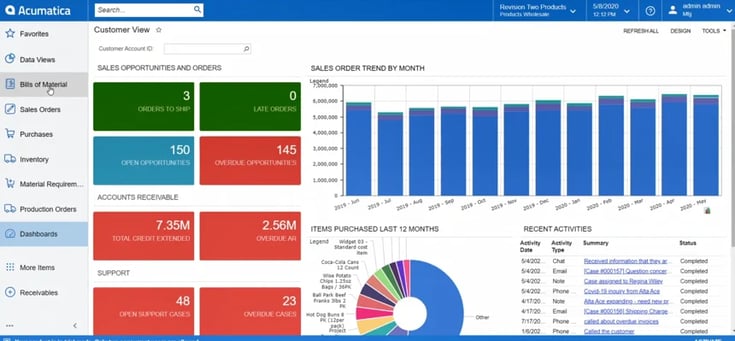
KPIs are not about tracking everything the system is capable of measuring. They exist to answer the questions that come up every week.
Are we producing profitably?
Are we meeting customer commitments?
Where are costs drifting before they show up at month end?
What needs attention now instead of after the quarter closes?
When KPIs are accurate and timely, manufacturers can manage performance as it happens. When they are delayed or unreliable, teams fall back on experience, instinct, and after-the-fact explanations instead. Over time, that gap makes it harder to grow without adding risk.
In many manufacturing environments, KPIs live outside the ERP and are pulled together after the fact.
Production data may live in one system. Inventory data in another. Financials are finalized at month end. KPIs are then built in Excel to stitch everything together.
This creates predictable problems:
Metrics lag behind what is happening
Different teams work from different numbers
Finance spends time validating data instead of analyzing it
Operational issues surface only after they become expensive
The KPIs themselves are usually reasonable. The problem is that the process behind them does not scale.
Take a mid-sized plastics manufacturer tracking margin by job.
Job costs are captured in the ERP. Material usage is recorded separately on the production floor. Overhead is allocated at month end. Finance reconciles everything in Excel before leadership sees final margin numbers.
By the time the data is clean, the job is finished, the customer has been invoiced, and it is too late to correct pricing, production efficiency, or material usage.
The KPIs exist. They just arrive after the decisions are already made.
There is no universal KPI list that works for every manufacturer. The right KPIs depend on how the business operates and which decisions need better visibility.
Instead of starting with a generic list, start with the questions that come up most often in leadership and operations meetings:
“Why is margin lower this month?”
→ Track cost variance and labor or overhead absorption by job
“Can we take on this rush order?”
→ Track capacity utilization and schedule adherence
“Why are we always short on this material?”
→ Track inventory turns and lead-time variance
The KPIs worth tracking are the ones that answer recurring questions without extra work.
KPIs also work best when ownership is clear. CFOs tend to focus on margin by job or product, cost variance, and absorption to understand profitability trends. Plant managers care most about throughput, downtime, and execution against plan. Schedulers and planners rely on capacity utilization and schedule adherence to make daily tradeoffs without creating downstream problems.
When each role sees KPIs tied to the decisions they are responsible for, dashboards stop being passive reports and start supporting real action.
Financial KPIs connect day-to-day operations directly to profitability and cash flow.
Examples include gross margin by product or job, cost of goods manufactured, labor and overhead absorption, and working capital trends. When these metrics are tied directly to production and inventory activity, finance can see margin pressure developing before it shows up in financial statements.
That timing matters. It gives teams room to respond while options still exist.
Operational KPIs reflect what is happening on the shop floor.
Metrics such as on-time delivery, schedule adherence, inventory turns, and plan-versus-actual hours and costs help surface execution gaps while production is still in motion. They support better coordination between planning, production, and fulfillment.
Without timely operational KPIs, small issues tend to snowball.
Capacity and utilization KPIs show how effectively labor and equipment are being used.
Machine utilization, labor utilization, production throughput, and downtime trends are especially important for growing manufacturers. Without clear visibility into capacity constraints, planning becomes reactive and overtime becomes the default response.
These KPIs support more realistic planning and more sustainable growth.
When KPIs are built directly inside the ERP, financial and operational data stay aligned by default.
Metrics update as transactions occur. Dashboards reflect real performance rather than estimates. Teams spend less time debating which number is correct and more time responding to what the numbers are telling them.
This is where platforms like Acumatica make a difference. Manufacturing, inventory, and financial data all live in a single connected system, so KPIs reflect the full operational picture without manual reconciliation.
In Acumatica, production labor, material issues, and overhead flow into job costing automatically. As work is completed, margin by job updates in real time, giving finance and operations visibility while there is still time to adjust — not weeks later.
“The value of KPIs is not in producing reports. It is in enabling better decisions.”
The value of KPIs is not the report itself. It is what happens next.
When manufacturers have timely, trusted KPIs, finance can spot margin erosion earlier, operations can correct scheduling and capacity issues sooner, and leadership can make informed decisions without waiting for month end.
That is the difference between measuring performance and actively managing it.
KPIs do not solve manufacturing challenges on their own. But when they are accurate, visible, and tied directly to the ERP, they become one of the most effective tools for improving performance across finance and operations.
If KPI reporting feels slow, fragmented, or difficult to trust, the issue is usually not the KPIs themselves — it is whether the ERP can still support how the business operates today, whether that means tracking margin by job in a custom manufacturing environment or maintaining schedule adherence in a make-to-stock operation.
At Milestone Information Solutions, we work exclusively with Acumatica. We help manufacturers move off legacy or limiting systems and onto a connected platform that supports real-time operational and financial visibility.
Not sure if you have outgrown your ERP?
Let’s spend 30 minutes walking through how your team tracks performance today and where visibility starts to break down.

See how cosmetics manufacturing ERP helps connect inventory, landed costs, production, lot tracking, eCommerce orders, returns, and reporting.
Outgrowing QuickBooks? Learn the signs that reporting, access, add-ons, multiple entities, and manual work may mean it is time to evaluate ERP.
Learn how accounting software for multiple businesses helps finance teams manage intercompany transactions, reporting, and financial visibility.